
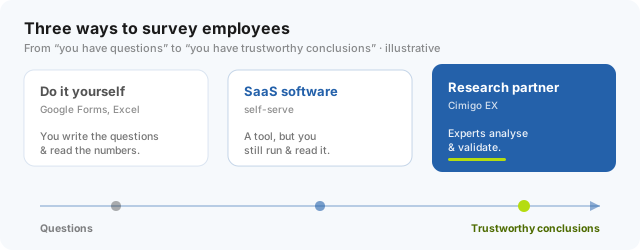
Which approach to choose depends on what you need at the end: questions, or trustworthy conclusions you can act on. To survey employees you have three options — do it yourself with Google Forms, use SaaS software, or hire a research partner — and they differ mainly in who analyses the data and how far you can trust the numbers, not in how many features they have.
Three ways to survey employees
- Do it yourself (Google Forms, Excel): you write the questions, send them, and aggregate the answers. Cheap and fast to start, but with no standard question set, no validation and nobody to read the numbers for you.
- Self-serve SaaS software: gives you ready-made templates and automatic dashboards. More convenient than Google Forms, but at heart you still run and interpret it yourself — the tool produces numbers; understanding and deciding stays with you.
- Research partner (Cimigo EX — employee experience): you build and send the survey yourself from a research-grade template, then Cimigo experts analyse, validate and return an action dashboard within 1–3 days.
Compare on what actually matters
Don’t compare on “who has more features” — compare on what decides whether you’ll dare to act on the results.
| DIY (Google Forms) | SaaS software | Research partner (Cimigo EX) | |
|---|---|---|---|
| Who designs the questions | You | Built-in template | Research-grade template |
| Who analyses & validates | You | You (tool dumps numbers) | Cimigo research experts |
| Trust in the numbers | No validation | Up to your reading | Sample size & quality checked |
| Anonymity for honest answers | On your own | Yes, basic | Identity split + small-group threshold |
| What you get back | A response sheet | A dashboard to read | Conclusions you can act on |
| Best when | Quick ask, small team | You have a data reader | You need evidence for a big call |
The crux: Google Forms and SaaS software both stop at handing you the numbers; the hardest part — turning numbers into trustworthy conclusions — stays on your shoulders. That’s also why the first two columns are cheaper: you’re paying yourself for the work.
When is Google Forms (or DIY) enough?
To be honest: you don’t always need a research partner. DIY is enough when you only need a quick question for a small group, the results won’t drive a big decision, and you accept the numbers as indicative. For example: asking opinions on a team-building venue, or a quick pulse after a training session.
You should consider research-grade when: the results will be used to allocate budget or retain top talent, you need to guarantee anonymity so employees answer honestly, or you want to compare eNPS and the Commitment Index across departments reliably.
Cost: cheap is paid in money, expensive is paid in wrong decisions
DIY is almost free in money, but the real price is the risk of a wrong decision based on unvalidated numbers — plus the HR time spent aggregating, cleaning and interpreting. A research partner charges per survey wave, by headcount; you pay more to not carry the analysis yourself and to get numbers trustworthy enough for a people decision worth hundreds of millions.
If you’re still unsure how often to survey whichever approach you pick, see how often you should survey employees. And if you already know you need conclusions, not just a sheet of numbers, see how pricing works per wave for Cimigo EX.